
English| EUR
Suggested for you
More currencies
Choose a language
The Dikteon Cave in Psychro opens Tuesday through Sunday from 10:30 to 17:30 and closes every Monday. Entrance costs 15 EUR per person, and the 200-step descent into the mythological birthplace of Zeus requires sturdy footwear and a tolerance for steep, uneven stone.
Quick answer
The Zeus Cave in Psychro, Lasithi Plateau, opens Tuesday through Sunday from 10:30 to 17:30 and remains closed on Mondays. Entry costs 15 EUR per person. Arrive between 10:30 and 12:00 to avoid midday tour groups and the heat of the uphill return climb—the site lies 200 steps below the ticket kiosk.
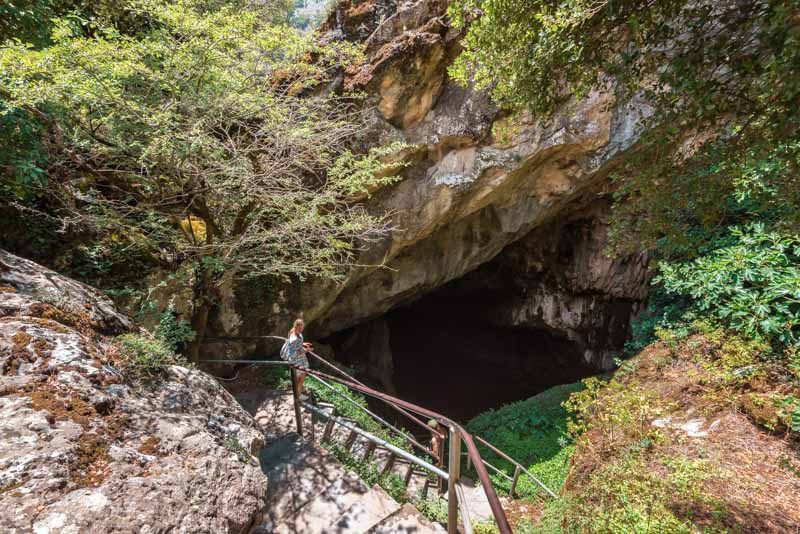
The Dikteon Cave—known widely as the Zeus Cave—sits 1025 meters above sea level on the Lasithi Plateau, a windswept highland ringed by the Dikti Mountains. According to Greek mythology, the Titan Rhea hid her newborn son Zeus here to protect him from his father Cronus, who had swallowed his other children to forestall a prophecy. The cave remained a sanctuary site through the Minoan period, and archaeologists recovered bronze figurines, pottery, and votive offerings from its chambers in the early twentieth century. Today the site operates under the Hellenic Ministry of Culture, and its narrow stone stairway draws visitors who descend into a sequence of stalactite-filled galleries that terminate at a shallow underground lake. The Zeus Cave Crete opening hours follow a six-day schedule: the entrance gate unlocks at half past ten each morning from Tuesday through Sunday, and the last ticket is sold at half past five in the afternoon. The cave closes entirely on Mondays for maintenance, a closure that catches unprepared travelers who arrive in Psychro village without checking the weekly rhythm. The 15-euro entrance fee grants access to the stairway and the cavern below, but it does not cover the services of the donkey handlers who wait at the trailhead to offer rides up the initial slope—those negotiations happen independently, and the animals are not necessary for anyone with functional knees and twenty minutes to spare. The site's position on the plateau means that summer heat intensifies by midday, and the unshaded path from the parking area to the cave entrance becomes punishing under the July and August sun. Tour buses from Heraklion and Agios Nikolaos typically arrive between noon and two in the afternoon, filling the stairwell with groups that move slowly and photograph every formation. Visitors who reach the ticket booth at opening time encounter an empty cave and complete the descent without queuing. The return climb—200 steps up the same stone staircase—demands more effort than the descent, and the cooler morning air makes that ascent tolerable rather than miserable. The cave itself is not vast. The main chamber measures roughly forty meters in length, and the formations—while genuine and geologically significant—do not rival the scale of commercial show caves elsewhere in Europe. The underground lake at the far end remains shallow year-round, its surface reflecting the beam of every visitor's phone torch. The acoustics are remarkable: footsteps echo, and whispered conversations carry across the stone. The pathway is lit with minimal electric lighting, so a handheld torch or phone flashlight is useful for inspecting the finer details of the stalactites. The entire visit, from ticket booth to exit, typically spans forty-five minutes to an hour, including photography and a pause at the lake. Psychro village offers limited infrastructure—a handful of tavernas, a small parking area with a per-vehicle fee, and roadside stalls selling honey and woven goods. The drive from Heraklion takes ninety minutes via the northern coast road and the winding ascent through Potamies. The Lasithi Plateau itself is worth the journey: a vast, fertile plain dotted with white-sailed windmills and stone farming settlements. The cave is one of several mythological and archaeological sites on the plateau, and travelers who plan a full day can combine the visit with stops at the nearby villages of Tzermiado and Agios Georgios.
“The cave remained a sanctuary site through the Minoan period, and archaeologists recovered bronze figurines, pottery, and votive offerings from its chambers.”
The Dictaean Cave, commonly known as Zeus Cave, maintains a consistent weekly operating schedule. It remains open from Tuesday through Sunday, with the site closed to visitors on Mondays.
The cave is located at Psychro, 72053, on the Lasithi Plateau in Crete, Greece. The most reliable way to reach the site is by private or rental vehicle, as the plateau is situated in a mountainous region.
Follow the provincial road towards the Lasithi Plateau and continue to the Psychro village access point
KTEL bus service from Heraklion to the Lasithi Plateau
Parking is available near the base of the trail in Psychro. From there, follow the clearly marked path to reach the access point for the cave.
Everything you need to know about zeus cave crete opening hours
The zeus cave crete opening hours are 10:30–17:30 daily, except for Mondays when the site is closed. Please check these times before planning your trip to the Lasithi Plateau.
The Diktaion Andron, often called the cave of Zeus, is closed on Mondays. From Tuesday through Sunday, it maintains consistent zeus cave crete opening hours from 10:30 to 17:30.
The entrance fee is 15 EUR per person for a full ticket. This price covers access to the archaeological site managed by the Ministry of Culture.
To avoid peak crowds and extreme heat, the best arrival window for this historical landmark is between 10:30 and 12:00. Arriving early helps ensure a more comfortable experience during the uphill hike.
The path leading to the cave entrance involves 200 steps. Visitors should prepare for a moderate climb to reach the site interior.
While the cave remains accessible until 17:30, visiting during the midday heat can be taxing due to the uphill nature of the trail. The zeus cave crete opening hours are designed to accommodate daytime visitors, but early morning remains the most favorable time.